
Discovery File
Seeing Through the Politics
The Discovery File is the analytical engine of the Court of the Republic, designed to strip away political rhetoric and expose the "mechanical reality" of governance. It identifies the Delta—the gap between what a politician says to voters and what they actually do for donors.
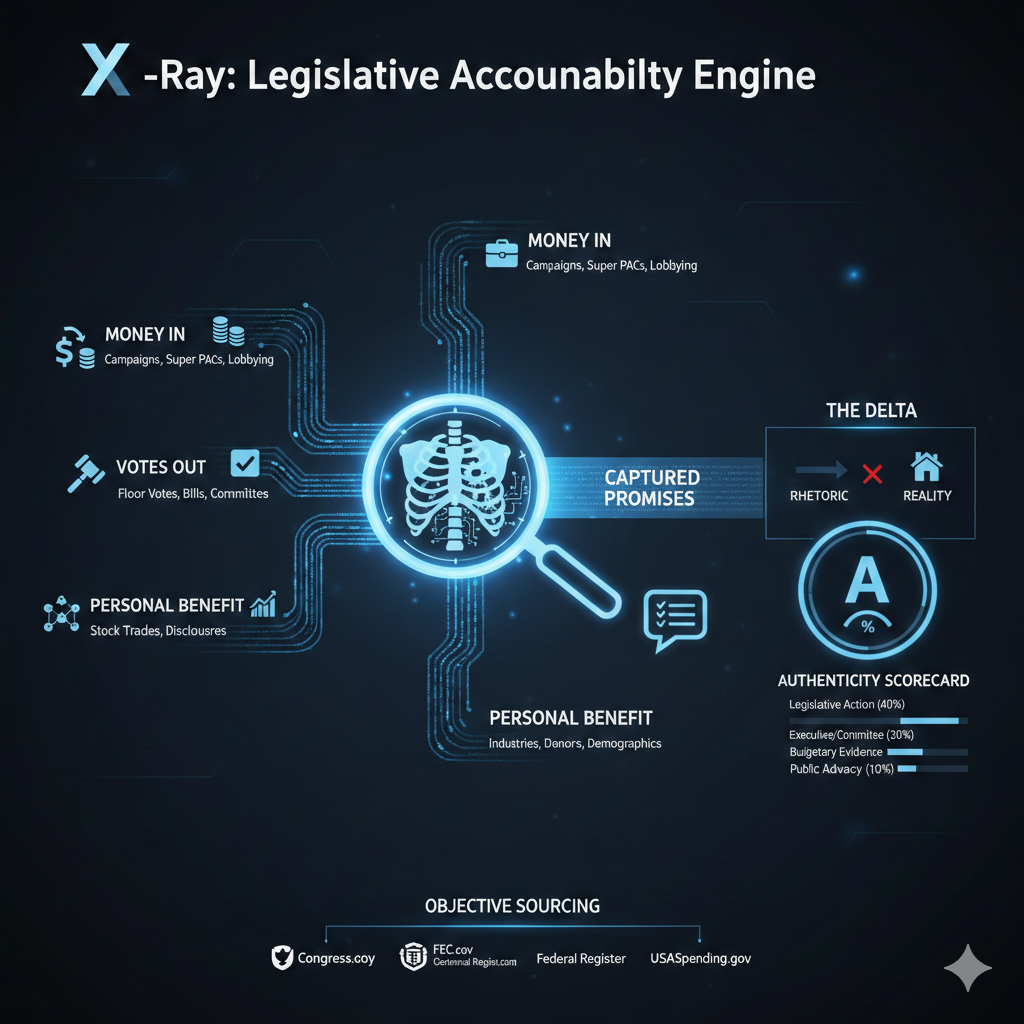
The Bottom Line: The Discovery File doesn't tell voters what to think; it shows them who their representatives are actually working for, allowing them to make informed decisions and financial contributions via the Grassroots Donation Portal.
By integrating four distinct data streams, the Discovery File creates a transparent map of influence and action:
1. The Four Primary Data Streams
Money In (The Input): Tracks all financial inflows, including individual campaign contributions, Super PAC spending, and deep-tier lobbying relationships.
Votes Out (The Output): Real-time monitoring of floor votes, committee votes, and bill sponsorships sourced directly from official .gov APIs.
The Beneficiaries: A granular analysis of who actually benefits from a specific vote—identifying specific industries, income brackets, or geographic regions.
Personal Benefit: Correlates a legislator’s personal financial disclosures and stock trades with their committee assignments and non-public legislative knowledge.
2. Mapping the "Delta"
The core function of the Discovery File is to compare these data streams against Data Stream Five: Captured Promises. The system archives campaign pledges and categorizes them by their "falsifiability" (how easily they can be proven true or false).
The Discovery File then highlights the contradictions. For example, if a candidate promises environmental protection but consistently votes for subsidies for heavy polluters who are also top donors, the Discovery File makes this "Delta" visible to the public without editorial bias.
3. Integration with the Authenticity Scorecard
The data gathered by the Discovery File feeds directly into the Fidelity Rating found on the Capitol Register. This converts complex data into a simple letter grade (A–F) based on:
Legislative Action (40%)
Executive/Committee Monitoring (30%)
Budgetary Evidence (20%)
Public Advocacy Documentation (10%)
4. Objective Sourcing
To maintain its integrity, the Discovery File relies exclusively on high-integrity, official sources:
Congress.gov (Legislation)
FEC.gov (Campaign Finance)
Federal Register (Executive Actions)
USASpending.gov (Financial Awards/Contracts)